Milez
On the Come UpMilez is a teenage rapper introduced as the self-styled “Swagerific prince” and Brianna Jackson’s opponent in the Rookie Royale at The Ring. His commercially successful persona—complete with a catchy song and a dance popular with children—sets up a sharp contrast with Brianna’s more personal, improvisational approach to rap. In the battle, his taunts invoke the murder of Brianna’s father, Law, turning the contest from a test of swagger into a confrontation over grief and identity. Brianna wins, and Milez’s role helps establish the book’s recurring question: who gets to decide whether a rapper’s performed image is merely a role or a truthful account of who they are?
Introduction and Public Image
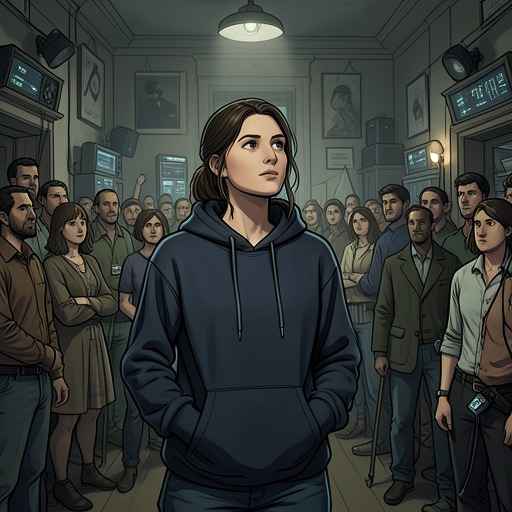
Hype announces Milez as the first MC drawn for the Rookie Royale. The crowd cheers as a brown-skinned boy with zigzag patterns cut into his hair walks toward the Ring; a large cross pendant hangs from his chain. Brianna recognizes him only vaguely at first, then connects him to a song she has heard repeatedly around the neighborhood.
Milez introduces himself as “Milez with a z, the Swagerific prince!” His signature track, “Swagerific,” repeats its own boastful hook, while its accompanying “Wipe Me Down” dance has made it popular with little children. Brianna notes that the video has around a million online views. The contrast is deliberate: she regards the song as irritating and its claims as silly, yet its reach and the audience’s enthusiasm show that Milez has achieved the sort of visibility a battle rapper might want.
He also publicly acknowledges Supreme as his father, pointing him out with a shout-out. That connection places the young performer within the music-business world that later becomes central to Brianna’s own decisions. Milez’s introduction therefore presents more than a rival arriving at the Ring: it places a polished, recognizable persona before an audience already primed to respond to it.
The Rookie Royale Battle
Before taking her turn, Brianna imagines attacking Milez’s claim to be an authentic gangster, including the gems in his pendant. His performance changes the stakes. As she waits, he continues rapping about being a gangster, then directs a verse at her that compares killing her to the person who killed her father. The line makes Law’s murder a weapon in an event that had appeared to be a contest of boasts and punchlines.
Brianna’s imagined rebuttal gives way to a moment of hesitation, but the battle proceeds. When the judges’ signs are raised, CZ’s reads “Li’l Law.” Hype declares Brianna the winner and raises her arm amid thunderous cheers, announcing her as the night’s Rookie Royale champion. The result establishes her success at The Ring while leaving the emotional cost of Milez’s attack visible: the victory is not simply proof that she can out-rap a rival, but that she can keep performing after he has turned her family’s loss into material.
Image, Authenticity, and the Music Business
Milez’s gangster posturing sits within a wider conflict over how a public image can be mistaken for a person’s true identity. After an encounter in a parking lot, Supreme tells Brianna that people will frame what happened through a “Ghetto Rapper” headline and advises her to use the role others expect of her to her advantage. His advice treats public perception as something that can be strategically managed, but also acknowledges how quickly an audience imposes a script.
Later, when Brianna rejects Dee-Nice’s ghostwritten song because it does not feel like her own, Supreme argues that music is a business and describes coaching Law to rap about street life and associate with the Garden Disciples so that he would appear authentic. He says that Law took the performance too seriously, and urges Brianna to play a role without becoming it. That account gives the Ring battle an additional resonance: Milez’s gangster persona is part of a culture in which performed toughness can be rewarded, while the consequences of being read as that persona may reach beyond the stage.
Milez himself does not reappear in the supplied account of Brianna’s later career, so the book does not establish how he responds to losing or whether he changes his act. His narrative importance lies in the encounter’s pattern: the audience receives a packaged persona, Brianna is targeted through an intimate wound, and the battle’s outcome gives her a public win without making the larger dispute over authenticity disappear.
Brianna’s Counterstatement
The book later develops the tension between performed image and personal truth through Brianna’s own music. In a freestyle, she refuses to be a joke, a mascot, or the reason a child joins a gang; she also rejects being a puppet or a copy, and insists that she will not claim words as her own if they are not. Her lyrics describe herself as a daughter, sister, hope, and mirror, and distinguish speaking about the violence she sees from claiming that violence as her own identity.
That response reframes the battle with Milez without erasing its specific injury. His verse makes Law’s death part of his performance; Brianna’s later work refuses the assumption that rapping about a subject means embodying it. The cheers that follow her freestyle echo the acclaim at the Rookie Royale, but now the applause answers an explicit statement of artistic independence. Milez’s brief role thus helps introduce the distinction between image and self that Brianna will have to defend against rivals, business pressures, and public interpretations of her songs.